



Conferences
A history of living: the villa. Places, types, functions and... beauty
Caprarola (VT)
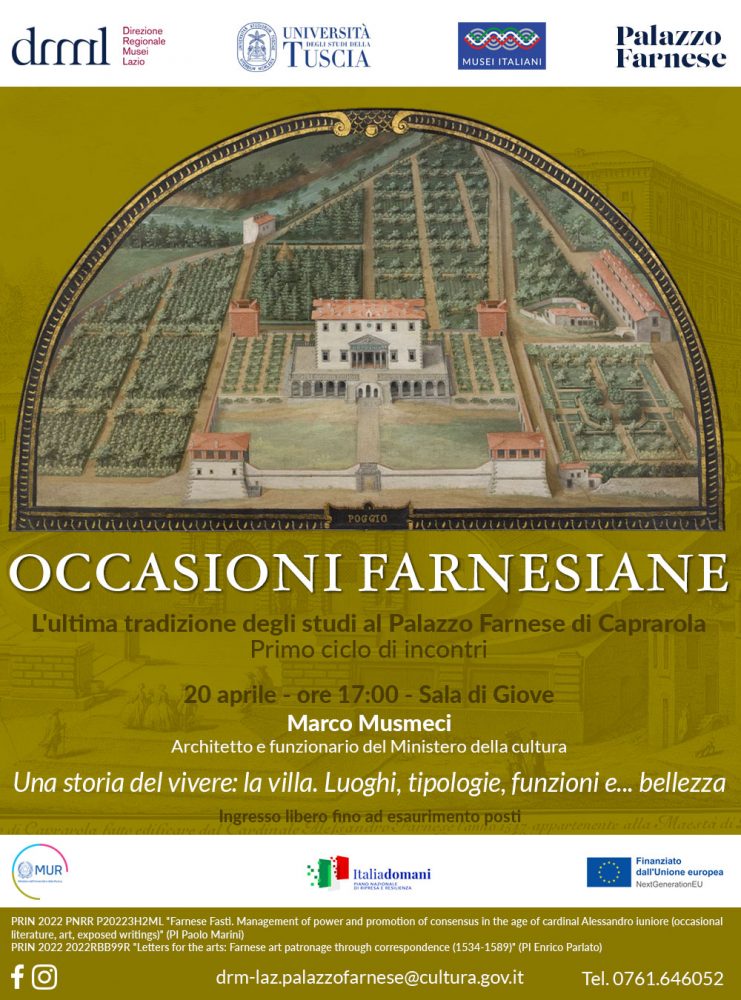
Palazzo Farnese in Caprarola (VT), April 20, 2024, 5 p.m.
A history of living: the villa. Places, types, functions and... beauty
Lecture by Marco Musmeci
With the lecture A history of living: the villa. Places, typologies, functions and... bellezza -first meeting of the cycle "Farnese Occasions"-arch. Marco Musmeci will propose, an excursus on the history, spatial composition and representativeness of one of the most fascinating types of architecture of every era.
The path, although necessarily synthetic, will start from the distinction made by Vitruvius, with the models of Antiquity (urban and rustic type), and then unfold in the Renaissance, up to the great mansions of the sixteenth century and the Royal Palaces of European dimension.
The theme, of considerable complexity because of the considerable facets, which over the centuries have developed or added to an original idea, will provide an opportunity to reflect on extremely famous cases such as the imperial villas (Hadrian's Villa in Tivoli, Diocletian's Palace in Split) or for the particular construction elements, on lesser-known buildings such as the Villa of Marcus Terentius Varro in Casinum; it will also be an opportunity to rediscover, in a discourse made up of cross-references and suggestions, the Arab-Norman holiday residences and, also recognized as UNESCO World Heritage Sites, the Medici villas, the Este delights and the Savoy residences.
This journey through places and architecture will take us to the modern age, to the triumph of typology with the work of Palladio, where the villa becomes the center of the patron's representativeness. In the 16th century, the villa is no longer just a place of vacation or agricultural garrison, but also through the theatrical theatricalization of spaces and artistic/decorative apparatus, a place of personal and dynastic celebration, such as that of the Farnese family in Caprarola.
Marco Musmeci, an architect and official of the Ministry of Culture, was director of the National Archaeological Museum in Cassino and the Archaeological Park of Casinum and, director of the Archaeological Park of Minturnae and the Royal Ferdinand Bridge in Minturno. He is an adjunct university lecturer at the University of the Republic of San Marino and the University of Modena and Reggio Emilia. He currently holds the position of Councillor for Culture and Deputy Mayor in the Municipality of Montegridolfo in the province of Rimini. Within European cultural projects, he has carried out numerous researches on the theme of the villa.