




Conferences
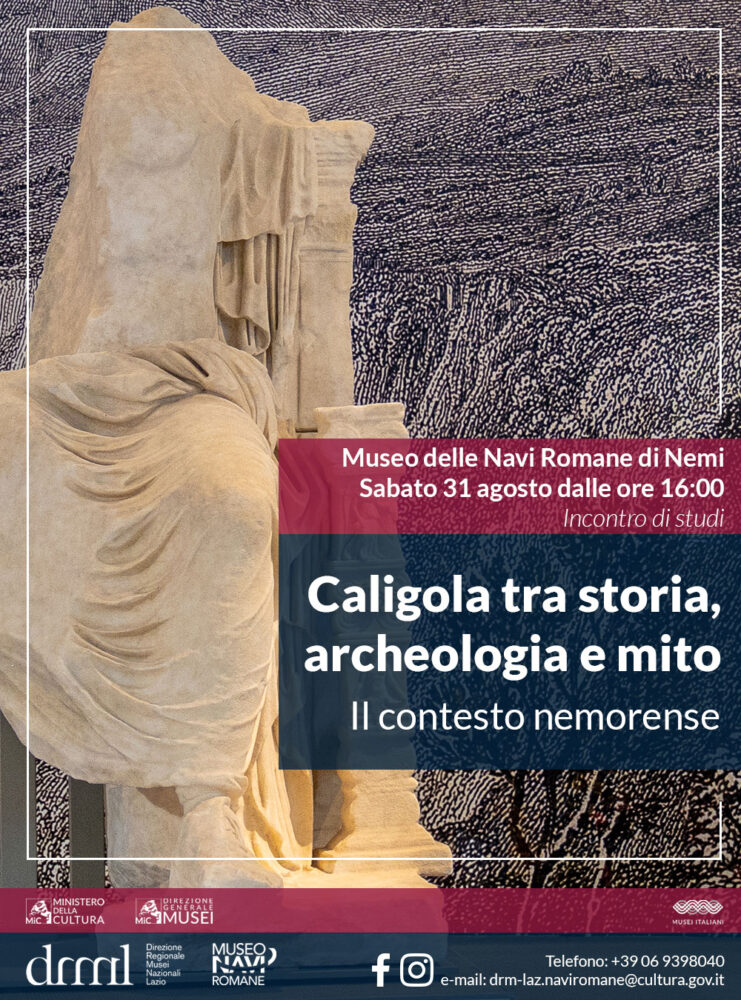
CALIGULA BETWEEN HISTORY, ARCHAEOLOGY, AND MYTH. The nemorense context
Nemi (RM)
MUSEUM OF ROMAN SHIPS OF NEMI
Saturday, August 31
CALIGULA BETWEEN HISTORY, ARCHAEOLOGY AND MYTH. The nemorense context
On the occasion of the anniversary of the birth of Caius Caesar Germanicus (Aug. 31, 12 A.D.), the Museum of Roman Ships in Nemi, directed by Daniela De Angelis, afferent to the Regional Directorate National Museums Lazio, headed by Elisabetta Scungio, is organizing a day dedicated to the third emperor of Rome, known as Caligula, famous for his excessive behavior.
Three moments will mark the day: at 4 p.m. there will be a Study Meeting entitled. Caligula between history, archaeology and myth.. The nemorense context, which will host a series of talks curated by scholars who have been dealing for years with the figure of Caligula and his relationship with the nemorense territory, where his influence was strong.
The figure of the emperor sees in ancient sources, hostile to him, a chronicle describing his excesses and insane behavior, especially during the latter part of his reign, leading up to the removal of his public image with the damnatio memoriae to which he was subjected after his death.
The archaeological record that has come down to us shows us how Caligula tried to convey a specific image of himself, with a strong control of his public figure and the honors bestowed on him, with the aim of representing his power without limitations.
This day will be an opportunity to reflect on different aspects of the figure of the emperor who ruled from 37 to 41 CE, and provide a rereading of his work with a historical analysis that goes beyond the literary stereotype of the mad tyrant devoted to excesses.
From 7 p.m. to 11 p.m. special evening opening, to appreciate the Museum and its collections at sunset while enjoying the extraordinary landscape that surrounds it.
At 7 p.m., a site-specific work from the "Antichi Sipari" review, curated by Daniela De Angelis in collaboration with the Mobile Theater Association, will be staged: the ancient sources' depiction of Caligula as a cruel emperor and tales of his excesses have become the subject of reinterpretation and inspiration for modern literary and poetic works, such as Albert Camus' "Caligula," staged on this occasion with an adaptation by Pina Catanzariti, directed by Marcello Cava.
Urban Experience's walkabout will accompany the play.
Program
Museum of Roman Ships, Via Diana 13-15 Nemi (RM)
Saturday, August 31
4 p.m.
Study meeting.
CALIGULA BETWEEN HISTORY, ARCHAEOLOGY AND MYTH. THE NEMORENSE CONTEXT
Institutional greetings
Introduces and moderates
Daniela De Angelis, Director of the Museum of Roman Ships
Gemma Carafa Jacobini, Soprintendenza Archeologia, Belle Arti e Paesaggio for the metropolitan area of Rome and the province of Rieti
Glyptics in the Julio-Claudian period
Francesca Diosono, Ludwig-Maximilians-Universität München, Institut für Klassische Archäologie
Archaeology of Caligula, from childhood to empire
Giuseppina Ghini, former Director of the Museum of Roman Ships in Nemi
Caligula and Lake Nemi between religio, amoenitas and political propaganda
Sara Scarselletta, Independent Researcher
Caligula and the Navigium Isidis: Eastern and Italic cults compared in the forest sacred to Diana Nemorensis
7:00 p.m.-11:00 p.m.
EXTRAORDINARY EVENING OPENING
7:00 p.m.
Theater review "Ancient Curtains"
Caligula. Fragments from Albert Camus by Pina Catanzariti, directed by Marcello Cava
-----------
This is how Suetonius describes Caligula in his work, delivering to modern literature the image of the mad emperor known to all:
So far we have talked about the prince, now we just have to talk about the monster. Not content with having taken a great many nicknames (in fact, he was called "pious," "son of the camp," "father of the armies," and "the best and greatest of the Caesars"), when one day he heard some kings, who had come to Rome to pay homage to him, arguing at the table, before him, about the nobility of their origins, he cried out:
"Let there be one leader, one king" [...] He also dedicated, to his deity, a special temple, a college of priests and very rare victims. In the temple there was a gold, life-size statue to which every day was put on a robe equal to the one he put on. [...]
[...] He was no less disrespectful and cruel to the senators: he allowed some of them, who had exercised the highest magistracies, to run with their togas, for very long stretches of road, beside his chariot, and to remain standing while he dined, now at the headboard, now at the end of his bed, with a towel around their waists. [...]
[...] Many people of high rank he first disfigured with the mark of infamy, then he condemned them to work in the mines or to build roads or to be mauled; or else he had them locked in cages on all fours like beasts, or he had them sawed in two, and not always for serious reasons, but because they had criticized a performance given by him, or because they had never sworn by his genius [i.e., by his protective deity]. [...]
[...] To his grandmother Antonia who sent him a grievance he said [...], "Remember that everything is permissible to me and towards everyone."
Suetonius, Lives of the Twelve Caesars, Book Four. Life of Caligula, 22, 26, 27, 29
