


Festival
GOLD FESTIVAL - 3rd edition
Caprarola (VT)
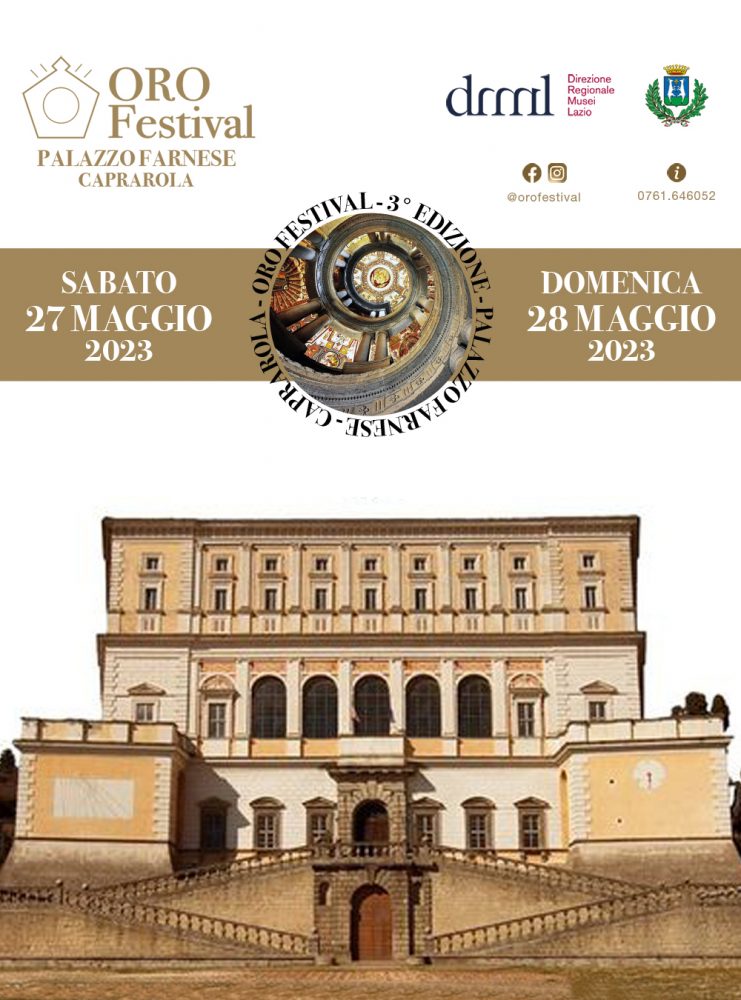
Now in its third edition, the Palazzo Farnese in Caprarola Oro Festival, the cultural literary review resulting from the collaboration between the Lazio Regional Museums Directorate, directed by Stefano Petrocchi, and the Municipality of Caprarola, represented by Mayor Angelo Borgna, in a now proven synergy with the Palazzo Farnese museum, returns on May 27 and 28.
Dense program for a two-day event that will see a core group of authors engaged in giving voice, with different languages and various narratives. "Voice" is in fact the word that guides the 2023 edition of Oro Festival, in the choice of curators Marina Cogotti and Graziano Graziani; voice as protest and as enchantment, as taking the word and as recomposing the shattered, in a path that sees a special dragnet of authors of literature and theater confront each other on what is the link between the spoken and the written word. But giving voice also means restoring possibilities of expression and participation to those who have no voice, or to those who have had it taken away from them, in a tight rhythm of testimonies that will be recounted in the scenic space of the Sala di Giove in Palazzo Farnese.
In the opening, a tribute to Don Milani, on the precise centenary of his birth (May 27, 1923) entrusted to Eraldo Affinati, a writer and educator who has dedicated two books to the prior of Barbiana, tracing the threads of the moral and political legacy of an experience born to give a voice to those children and parents who had never had the word. Instead, writer Christian Raimo and actor and author Claudio Morici will dialogue around the podcast "Willy, a boys' story," which reconstructs the story of Willy Monteiro Duarte, the boy beaten to death in Colleferro in 2020; a podcast created not to surrender to the inevitability of fate, but which takes the time to listen to the voices of the community in which the event happened. Closing the first day is Igiaba Scego with the presentation of her "Cassandra in Mogadishu," in the finalist dozen of the Strega Prize, which recounts the thread that connects the Somalia of Siad Barre and the civil war with the former colonizer, Italy, through a family affair that gives voice to uprooting precisely through words, Somali words, which find space alongside Italian words.
On the second day the dedication to one of the great voices of popular song, Rosa Balistrieri, recounted byIsabella Ragonese in her first documentary "Rosa. Il canto delle sirene," in which the story of the singer-songwriter and storyteller from Palermo becomes a symbol, even in the present, of the people crushed by patriarchal society who decide to confront it by taking back their voice. Maria Grazia Calandrone, on the other hand, tries to give back her voice to those who had to let her go, to Lucia and Giuseppe, the biological parents she did not know, victims of the social conditioning of rural Italy in the 1960s, in her novel "Dove non mi hai portata," a book in the Strega Dozen, which follows as a diptych the acclaimed work on her adoptive mother "Splendi come vita." Closing the day are Luigi Lo Cascio's "Storielle per crabs e scorpioni," short and not-so-short apologies that lend voice to animals and the anxieties of human beings, sketched with a refined taste between the absurd and the ironic by one of the most cultured interpreters of our cinema, no stranger to literary experiments, here in Caprarola in dialogue with poet Giorgio Maria Cornelio. Also contributing to the theme of "giving voice" are the presentations devoted to art, with the two volumes "The Castle of Carbognano Residence of Giulia Farnese. Le trasformazioni tra il XV e il XVII secolo," by Daniela Gallavotti Cavallero and Simonetta Valtieri, and "Il sorriso di Caterina," by Carlo Vecce, which restore role and merit to female characters historically conditioned by a narrative that has often reduced their role to a mere pawn in all-male power games, as in the case of Giulia Farnese 'the Beautiful,' or destined to oblivion, such as the mysterious mother of Leonardo da Vinci, who seems almost to re-emerge from the past to remind us of more current stories.
Participation in Oro Festival is free; admission to the Hall is allowed until all available seats are filled.
An admission ticket is required to visit the Palace.

PROGRAM
Saturday, May 27
11:00 a.m.
Daniela Gallavotti Cavallero, Simonetta Valtieri
The castle of Carbognano residence of Giulia Farnese. Transformations between the 15th and 17th centuries.
History, architecture, pictorial decorations
Margherita Eichberg speaks.
(Ginevra Bentivoglio EditoriA)
4:00 p.m.
Eraldo Affinati
The lesson of Don Milani
Homage to Don Lorenzo Milani, one hundred years after his birth
5:15 p.m.
Christian Raimo, Claudio Morici
Willy, a boy's story. Life death and beauty of Willy Montero Duarte. The Podcast
(Storielibere.fm)
6:30 p.m.
Igiaba Scego
Cassandra in Mogadishu
Strega Prize finalist book
interview Graziano Graziani
(Bompiani)
Sunday, May 28
11 a.m.
Carlo Vecce
Catherine's Smile. Leonardo's mother
interview Monica D'Onofrio
(Giunti)
3:45 p.m.
Isabella Ragonese
Rosa, ll canto delle sirene - documentary
interview Graziano Graziani
(Sky Arte)
5:15 p.m.
Maria Grazia Calandrone
Where You Didn't Take Me
Strega Prize finalist book
interview Graziano Graziani
(Einaudi)
6:30 p.m.
Luigi Lo Cascio
Little stories for crabs and for scorpions
Giorgio Maria Cornelio speaks.
(Feltrinelli)