



Concerts
Maxentius 2035
Tuscania (VT)
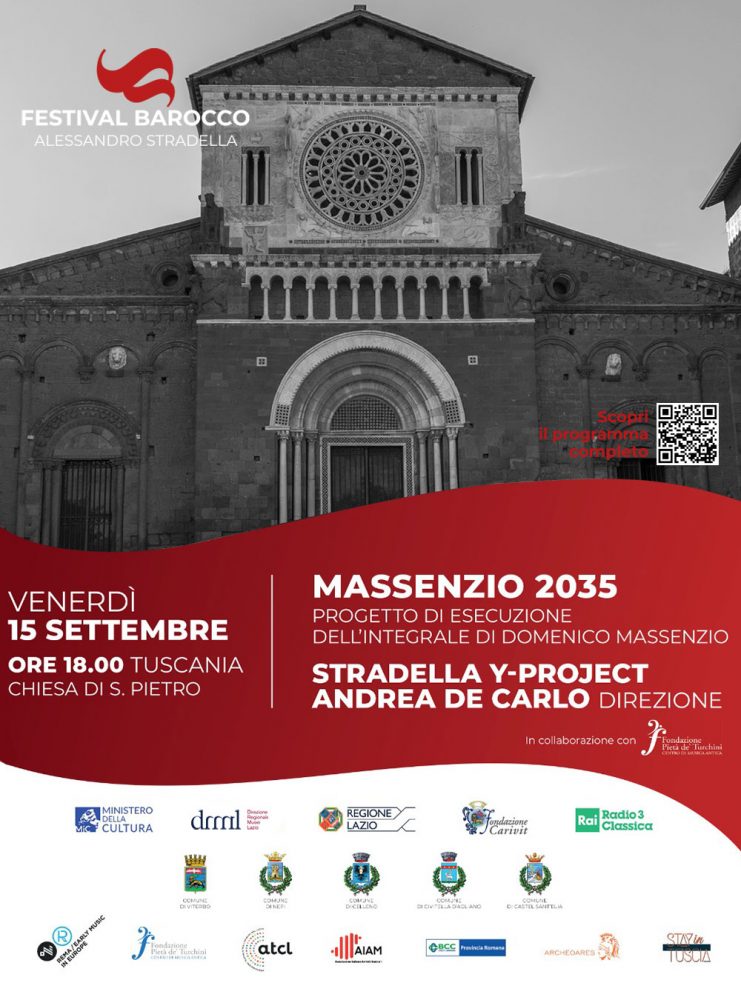
MASSENCE 2035
AVE MARIS STELLA
Program
Ave Regina Cælorum*
Hi sunt quibus deus*
Ave Maris Stella***
Beata Dei genitrix Maria°
Magi videntes Stella°
Quem vidistis, pastores?**
Stabat Mater**
O vos omnes qui transitis°°
Litaniæ Beatæ Mariæ Virginis**
Domenico Massenzio (Ronciglione, c. 1585 - Rome, October 23, 1657)
* BOOK I of the MOTTETTI Rome,1612
** BOOK II of the MOTTETTI 1614
*** BOOK III of Psalms 1618
° BOOK V MOTTETTI Rome, 1631
° BOOK III MOTTETTI Ronciglione, 1616
STRADELLA Y-PROJECT
Andrea De Carlo, conducting
Danni Oneill, cantus I
Benedetta Zanotto , cantus II
Danilo Pastore, altus
Angelo Testori, tenor
Benjamin Kazez, bassus
Serena Seghettini, viola da gamba
Irene Maria Caraba, viola da gamba
Anne-Sophie Eiselé, viola da gamba
Thomas Fields, violon
Johannes Festerling, theorbo and baroque guitar
Lucia Adelaide Di Nicola, organ
PROGRAM NOTES
The program AVE MARIS STELLA is intended to be an imaginary journey around the figure of Mary in its many complexities, through Domenico Massenzio's personal version of it throughout the course of his life.
Beginning with the antiphon Ave Regina Cælorum, contained in the first book of motets, a majestic portrait of the Marian image begins to be sketched, flanked, as in a brightly colored diptych, by that of the piece Hi Sunt quibus deus, celebrating the greatness of God, who was for men "a shelter from the dazzling light and rigors of the night, leading them through the great waters of the Red Sea."
The marine topos is then referred to the very ancient prayer Ave Maris Stella, with its natural images of great beauty and conceived by Maxentius in the "concertato alla romana" style (cit. Saverio Franchi), which accompanied and merged with great freshness the melodic suggestions of the new style with significant recoveries from the contrapuntal tradition, alternating in a play of chiaroscuro the use of one or two voices in alternation with the sound corpus of the five-voice "tutti."
The intercessory prayer Beata Dei Genitrix Maria introduces the theme of motherhood, which is taken up throughout the second part of the program: in Magi videntes Stellam and in Quem vidistis, pastores? we find all the joyfulness of the moment of the nativity seen from the perspective of shepherds and kings.
Such joy is followed, a baroque counterbalance full of meaning, by the painful second part of Mary's life as she experiences the loss of her only son and thus experiences the greatest suffering: Stabat Mater e O vos omnes qui transitis per viam are two poignant representations of this.
This Marian periplo can only conclude with the Litaniæ Beatæ Mariæ Virginis, during which there is a true musical catharsis, in a perfect apotheosis of repentance and glorification.
Discover the site

Info
6:00 p.m.