


Shows
Meeting with the poetry of Lillo Di Mauro
Tuscania (VT)
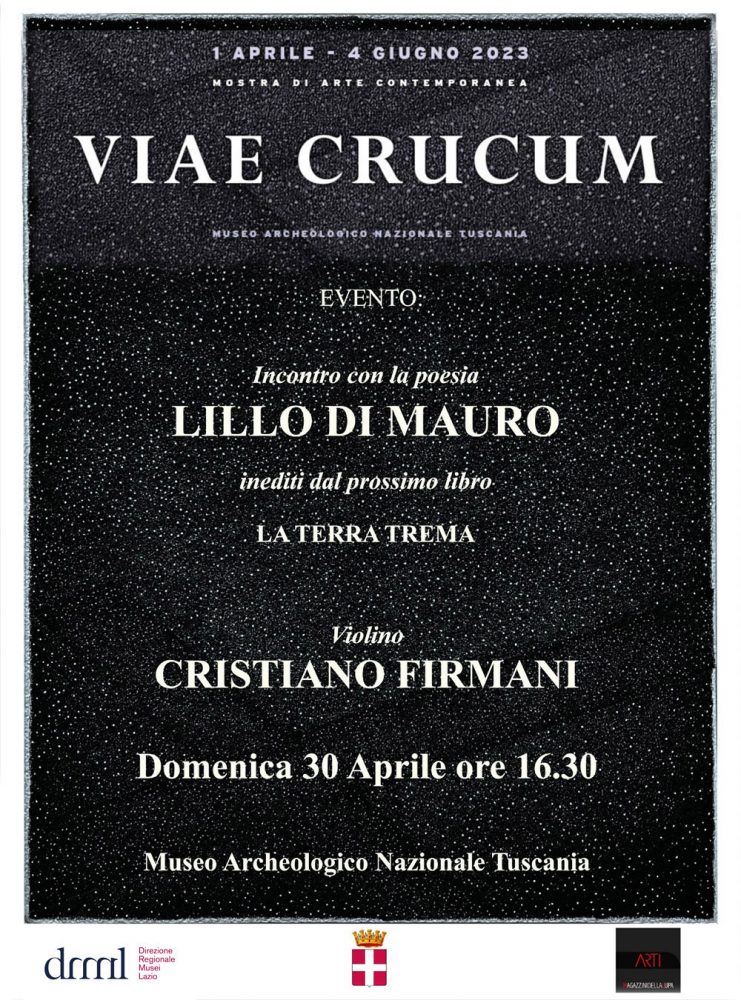
Meeting with Lillo Di Mauro 's poetry accompanied by Cristiano Firmani's violin.
Unpublished from the forthcoming book La terra trema.
On Sunday, April 30 at 4:30 p.m., the cultural association Magazzini della Lupa invites you to the National Archaeological Museum in Tuscania for Lillo Di Mauro's Encounter with Poetry. Young Cristiano Firmani, with his violin, will accompany Lillo Di Mauro in the poetry reading, taken from the unpublished sylloge "La terra trema," which will be published at the end of September by the Mario Luzi International Foundation.
The event has the patronage of the City of Tuscania and the Lazio Regional Museums Directorate and is within the project "Viae Crucum" contemporary art exhibition curated by Giuseppe Salerno (open until June 4), with works by: Tonina Cecchetti, Giulia Napoleone, Tommaso Cascella, Mirna Manni, Sandro Scarmiglia, Toni Bellucci, Maria Pizzi, Lughia, Maria Grazia Tata, Eva Gerd, Petra de Goede, Luigi Riccioni, Massimo De Angelis, Ambra Loreti, Lidia Bachis, Marco Paolini, Mario Becciu. Works that are visions of the world in which we live, traces of different paths and matured awarenesses placed on stage by artists who live the need to make manifest a feeling in front of which none of us is given to remain indifferent...
The poet Lillo Di Mauro with his verses, well places himself within "Viae Crucum," (i.e., the ways of crosses, of suffering), because his is a song of the soul that gives voice to pain and despair!
Lillo Di Mauro writes: "Poetry for me is the word that generates, the scream that reaches the sky, the dream. In everything I find poetry, it radiates from all things. Poetry has always answered my questions, it helps me penetrate the most remote aspects of my existence. I cultivate it like a flower in this world of hedonistic characters, I celebrate it like a ritual, from poetry I feel ennobled. In poetry even silence knows how to take shape, thanks to it I am able to represent the travails of my soul by overcoming the ordinary dimension of the everyday. Thanks to the poetic instrument capable of touching sensitive strings, I can go beyond conventional language and enter a parallel way of communicating, grasp in the word the signs and traits of love, of the desires of the body where even smells and moods acquire a tactile dimension. When I express myself in verse I recite prayers communicating with an unknown, imaginary elsewhere."
Lillo Di Mauro was born in Sutri (Viterbo) sixty-six years ago. Since adolescence he has been attracted to poetry and literature, art and beauty. His diverse sensibility grew within the new spaces opened by the emancipatory struggles of the 1970s. Always inserted in the social reality, he participated as a homosexual in the struggles for rights and recognition of the value of differences and still devotes himself, within the framework of volunteer work, to the protection and support of drug addicts, minors and prisoners, with particular reference to the children of prisoners and to imprisoned mothers with their children. He has published: The Rosy Horizon of Time (2021). In Silence... weaving thoughts (1981), Respect for Time (1983), Malia of the Wind (1985), Like a Breath (1989), Gabbie (2007; presented at Feltrinelli International as part of the cultural initiatives for Gay Pride) and Crumbs from the Ground (2015). He wrote and edited a tribute to Pier Paolo Pasolini Dove acqua di Tevero s'insala and the theatrical readings Patroclo e Achille and Passeggiate Romane.
Poetic word, emotion and sound in Sunday's meeting at the museum, where young Cristiano Firmani, with his delicacy and choice of playing specific pieces, will accompany the poet's verses with his violin.
This is how Cristiano tells his story, "I am 16 years old and I picked up a violin in my hand for the first time when I was 7 years old. It was my uncle's instrument, a violinist without passion until my teenage years. It was a discontinuous love for me, interrupted when I was 12 and then resumed last year. The violin is a complicated instrument, capable of enchanting angels and annoying devils. The bow vibrates on the strings and tells my mood. The violin reads me inside and I tell my story by giving it a voice ...."
It is said that the sound of the violin is the sound of the soul.
Let's say then that the soul-born verses of Lillo Di Mauro, a poet of rare and boundless sensitivity, and the soulful sound of Cristiano's violin will rise in the evocative encounter at the museum's cloister in a harmony of expression.
We look forward to seeing you on Sunday, April 30 at 4:30 p.m. at the National Archaeological Museum in Tuscania, Largo Largo Mario Moretti 1, 01017 Tuscania (Viterbo).
Free admission
Discover the site

Info
Largo Mario Moretti, 1, 01017, Tuscania (VT)
Free admission.
Phone: +39 0761 436209
e-mail: drm-laz.mutuscania@cultura.gov.it