




Conferences
Farnese Occasions
Caprarola (VT)
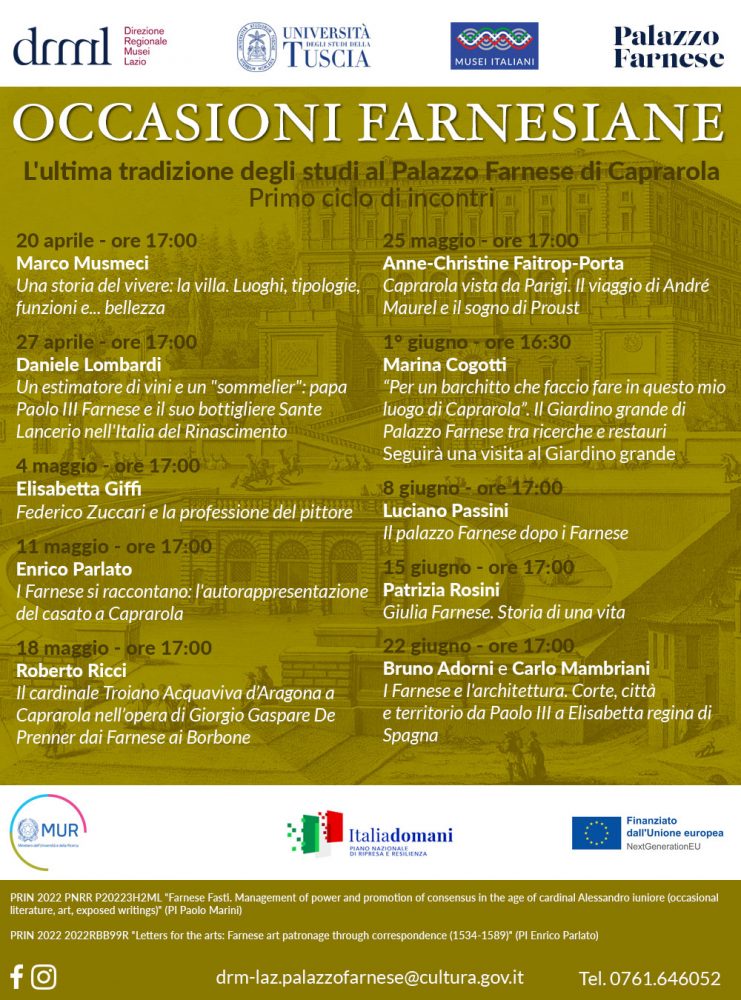
Farnese Occasions. The latest tradition of studies at the Farnese Palace in Caprarola. First cycle of meetings (April - June 2024)
Beginning on the afternoon of Saturday, April 20, in the halls of the Palazzo Farnese in Caprarola (VT), a series of ten meetings open to the public designed to disseminate new research being conducted on the Farnese and their articulated cultural universe kicks off.
Entitled "Farnesian Occasions," this first cycle of lectures scheduled from April to June will feature a series of specialists in historical, art-historical and architectural subjects who will discuss the most recent acquisitions in the field of Farnese studies. It begins with reflections on the space of the suburban villa in the Renaissance age proposed by Marco Musmeci. Daniele Lombardi then leads us to the table of Paul III Farnese to present the figure of Sante Lancerio, "sommelier" of the papal court as well as author of a remarkable writing on Italian wines published only in the 19th century.
Elisabetta Giffi presents her volume on the pictorial activity of a great protagonist of Caprarola's building sites such as Federico Zuccari, while Enrico Parlato widens his gaze to the entire program of family self-representation-from emblems to historical facts-that the Farnese developed in the decoration of the Palace. Roberto Ricci's talk is devoted to the 18th-century vision of the same palace in Georg Gaspar de Prenner's splendid engravings for Cardinal Troiano Acquaviva d'Aragona. Anne Christine Faitrop-Porta presents the point of view of illustrious early 20th-century Parisian travelers: from André Maurel's account to Marcel Proust's real dream of a stay in Caprarola.
We are brought back to the living and current reality of Palazzo Farnese by Marina Cogotti, with an overview of the Great Garden observed in its complex historical trajectory while a full restoration of the park is underway. Still of the Palace Luciano Passini reasons, but in a long-term perspective that even goes so far as to consider the seasons following the Farnese property.
The review closes in the first half of June with two presentations of volumes recently given to print: Patrizia Rosini discusses her book on Giulia Farnese, published about a decade after the edition of documentary materials on the life of the Bella; Bruno Adorni and Carlo Mambriani discuss the collection of studies they assembled and edited on the vast topic of Farnese architecture from the auroral age of Pope Paul III to the epilogue of Elizabeth Queen of Spain.
Conceived with a view to high dissemination aimed at all citizens, this cycle of "Farnese Occasions" stems from a scientific collaboration agreement made in 2023 between the Lazio Regional Museums Directorate, through regional director Stefano Petrocchi and the official in charge of Palazzo Farnese, Adele Trani, and some professors from theUniversity of Tuscia involved in two PRIN projects on the world of the Farnese in the age of Cardinal Alexander, funded by the PNRR and the Ministry of University and Research, Paolo Marini, Fausto Nicolai, Enrico Parlato, Paolo Procaccioli, and Pietro Giulio Riga.